
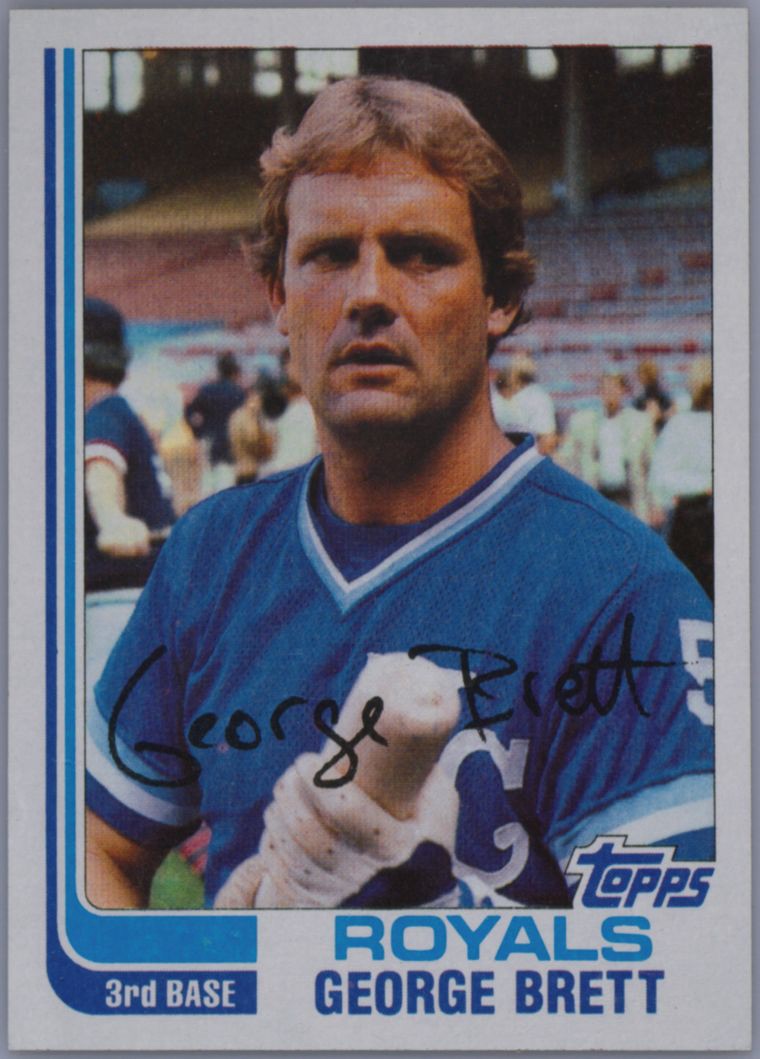
By 1982, the three-way competition between Topps, Fleer, and Donruss that had begun the previous year was firmly established, with each company releasing its second annual set. For collectors, 1982 is defined above all by a single name: Cal Ripken Jr.
Ripken made his major league debut with the Baltimore Orioles in August 1981, and 1982 was the year all three major card companies gave him a rookie card. He went on to be named American League Rookie of the Year in 1982, and his career — including the record-breaking consecutive-games streak that later earned him the nickname 'The Iron Man', made him one of the most collected players of his generation. His rookie cards from Topps, Fleer, and Donruss are all highly regarded, but it's the Topps Traded version of his rookie card, numbered separately from the main 1982 Topps set, that stands out as the most sought-after of the group. Topps Traded sets from this era were distributed only in complete boxed sets through hobby channels rather than in wax packs sold at retail, which means far fewer were produced compared to the base set, a scarcity that collectors have recognized for decades, making that particular Ripken card the standout of the whole 1982 class.
Ripken isn't the only notable rookie from 1982. Kent Hrbek, the Minnesota Twins first baseman who went on to a long career and a World Series title with his hometown team, also has his rookie card across the three 1982 sets, and it remains a solid piece for collectors focused on this year, even if it doesn't approach Ripken's level of demand.
By 1982, some of the rougher edges from Fleer and Donruss's first year in the market had started to smooth out, though both companies still had a reputation to build compared to the long-established Topps. Fleer continued to be associated with occasional photo and printing errors through the early 1980s, and variation-chasing collectors continue to comb through 1982 Fleer cards looking for these anomalies. Donruss, for its part, gradually improved its card stock and printing quality over these early years, though 1982 Donruss cards are still often found with centering issues that make sharp, well-centered examples harder to track down than raw print numbers would suggest.
As with the 1981 sets, condition plays an outsized role in the value of 1982 cards. A well-centered, sharp example of the Ripken Topps Traded rookie in particular can be dramatically more valuable in top grade than the same card in only average condition, which is why so many examples of this specific card have been submitted to grading services like PSA and BGS over the years. For any of the three base sets, cards with strong centering, clean corners, and original gloss will always command more collector interest than well-worn examples, regardless of the player.
For a collector focused specifically on 1982, the natural centerpiece is chasing the Ripken rookie across all three companies, Topps, Topps Traded, Fleer, and Donruss, which together tell the story of how a future Hall of Famer's first cards were split across four separate releases in a single year, a quirk unique to this particular window in the hobby's history.
Card values shift over time and depend heavily on condition, so anyone buying or selling should check a current price guide or recent completed auction results rather than relying on historical figures, but the fundamentals behind 1982's appeal to collectors, chiefly Cal Ripken Jr.'s emergence as a star, have remained remarkably consistent for over forty years.